Hudson River School
1825 – 1880
Catskill sunrises, Andean summits and still, glowing harbors - America's first landscape school
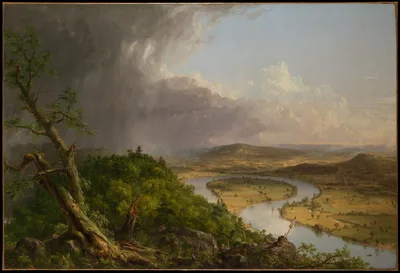 The Oxbow, 1836
The Hudson River School is the name later given to the loose fellowship of American painters who, from the mid-1820s through the 1870s, made the country's own scenery the central subject of serious art. In their lifetimes they were more often called the "native," "American," or "New York" school. Their pictures of the Hudson Valley and of the Catskill, Adirondack, and White Mountains combined close, detailed observation of rock, tree, and sky with an idealizing, often moral or spiritual, sense of what the American wilderness meant.
The movement is usually dated to the autumn of 1825. Thomas Cole (1801-1848), an English-born painter who had emigrated to the United States in 1818, took a steamboat up the Hudson, stopping at West Point and at Catskill Landing, and hiked into the eastern Catskills to sketch. Back in New York City he showed three landscapes based on those sketches in a bookseller's window. Colonel John Trumbull, the venerable painter of the Revolution, bought one at once and pointed the other two out to the artist and writer William Dunlap and the engraver Asher B. Durand. Dunlap publicized the discovery, and Cole was quickly welcomed into the city's cultural circles.
Over the next two decades Cole defined what an ambitious American landscape could be. He painted specific views - the Catskills, the Notch of the White Mountains, the oxbow of the Connecticut River seen from Mount Holyoke - alongside allegorical cycles such as The Voyage of Life, first painted in 1840 and repeated in a second set he made in Rome in 1842. In his Essay on American Scenery, published in the American Monthly Magazine in January 1836, he argued that wildness was the most distinctive feature of the American landscape and lamented "the ravages of the axe." He also taught: the Metropolitan Museum of Art identifies him as the teacher of Frederic Edwin Church.
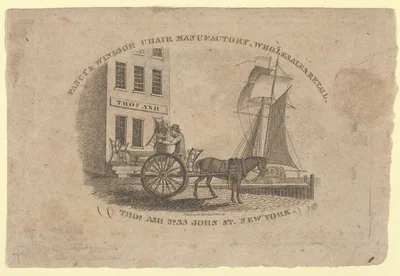
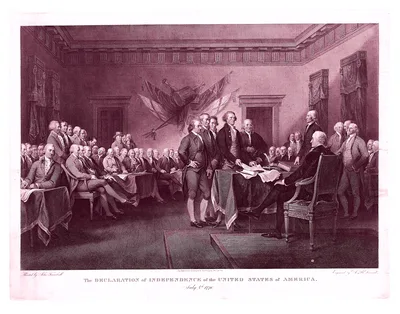
Cole died in February 1848. Leadership of the New York landscape painters passed to his friend Asher Brown Durand (1796-1886), who had trained and worked as an engraver - the archive holds his 1823 engraving of the Declaration of Independence and many of his banknote vignettes - before turning gradually to landscape painting in the 1830s. Durand was president of the National Academy of Design from 1845 to 1861. In 1849 he painted Kindred Spirits, a memorial showing Cole and the poet William Cullen Bryant together in the Catskill Mountains, commissioned by Jonathan Sturges as a gift to Bryant, who had delivered Cole's eulogy. (That painting is not in this archive: it belonged to the New York Public Library from 1904 until its 2005 sale to Alice Walton, and is now at Crystal Bridges Museum of American Art in Bentonville, Arkansas.) In 1855 Durand published his Letters on Landscape Painting in the New York journal The Crayon, urging students to go first to nature.
A second generation, whose finest works date roughly from 1855 to 1875, carried the school far beyond the Hudson. Frederic Edwin Church painted Niagara, the tropics of South America, and the Maine wilderness on a panoramic scale; his Heart of the Andes was shown on its own at New York's Tenth Street Studio Building from April 29 to May 23, 1859, and was a public sensation. John Frederick Kensett, Sanford Robinson Gifford, Jasper Francis Cropsey, Worthington Whittredge, Jervis McEntee, and William Hart worked the Catskills, the Adirondacks, the White Mountains, Lake George, and the New England coast, while others ranged to the American West and Europe. Kensett, Gifford, and Church were among the founders of the Metropolitan Museum of Art in 1870.
By the 1870s taste among American patrons had shifted toward the looser, plein-air manner of the French Barbizon School, and the detailed, panoramic Hudson River landscape fell out of fashion. The label "Hudson River School" itself belongs to this moment: it is thought to have been coined by the New York Tribune critic Clarence Cook or the painter Homer Dodge Martin, was first used somewhat disparagingly in the 1870s, and appeared in print by 1879. Interest revived after the First World War, ebbed again, and returned strongly from the 1960s; the Metropolitan Museum's 1987-88 exhibition American Paradise marked the school's full return to critical favor.
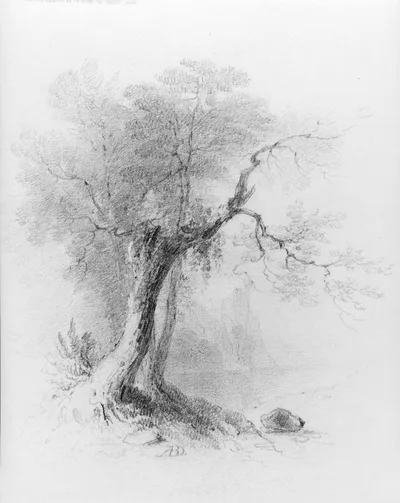
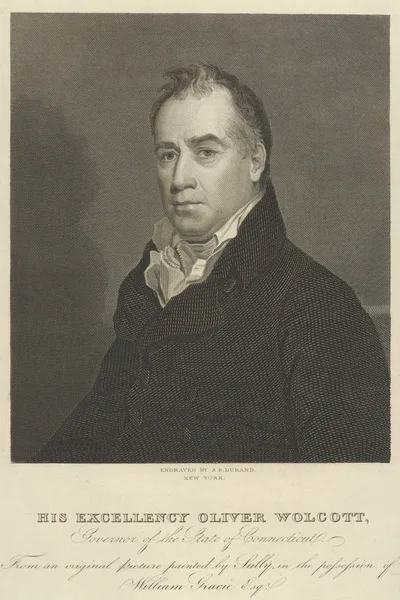
A Career in Images
"We are still in Eden; the wall that shuts us out of the garden is our own ignorance and folly."
— Hudson River School